The Great Dismal Swamp
The Great Dismal Swamp’s history of land exploitation, Black resistance, and Indigenous presence remains largely undocumented, even as it continues to shape the environmental justice struggles of the surrounding region today.
The Great Dismal Swamp once stretched across more than a million acres of what is now southeastern Virginia and northeastern North Carolina. Colonial land companies, including one founded by George Washington, drained it for farmland and logged it for cypress and cedar, cutting it down to the roughly 150,000 acres that remain today – much of what used to be swamp is now the cities of Suffolk, Norfolk, and Chesapeake. The Dismal Swamp Canal, still one of the oldest operating artificial waterways in the country, was dug almost entirely by enslaved Black labor, and some of the earliest fortunes in this region were built on draining the very land that had sheltered people fleeing slavery.
Just as this place was a space where wealth was built, so too was it a refuge – a recognized site on the Underground Railroad; enslaved people escaped into the swamp’s interior and built lives there, forming some of the largest maroon communities in North America on terrain considered too dangerous for anyone to follow. Its history runs even further back: Indigenous tribes moved through, traded in, and built legends around the swamp long before colonization, and remain connected to it today.
Now a National Wildlife Refuge, the Great Dismal Swamp is still an undercovered part of American history. There is a rich Civil Rights legacy in the region that is too infrequently connected to the history of land and labor exploitation that came out of the swamp; Black wealth-building and the push for educational freedom are a direct result of the communities who settled in and built lives for themselves in the hidden ecosystems of the Dismal. Today, the same communities shaped by the Dismal’s past sit at the center of present-day environmental justice fights, including flooding that disproportionately affects areas built on former wetland.
This collection attempts to document the diverse histories of the Dismal Swamp and surrounding region as well as the throughline connecting it to what communities here are still facing today.
This collection is made possible by the generous support of the National Geographic Society as a part of their Young Explorer Program.
Our Community Collaborators

Elder Benjamin Keeling

Chief Emeritus Sam Bass

Dominique Daye Hunter
We would like to extend deep gratitude to leadership at the Great Dismal Swamp Stakeholder Collaborative who shared their time, expertise, and credibility in helping us connect with community members and elders. This work and the resources featured on this page would not be here without their help.
Oral History Interviews
This collection includes interview conversations representing the range of people whose lives are tied to the Great Dismal Swamp. Narrators include coordinators of the Great Dismal Swamp Stakeholder Collaborative, descendants of significant historical figures connected to the swamp, lifetime residents who carry both Black and ecological histories of the region, members of the Nansemond Nation, and former U.S. Fish and Wildlife Service employees who spent their careers caring for the land itself.
CATHERINE “SPENCE” HOWARD
Lifetime resident of Pasquotank County and Hampton, VA
Transcript Coming Soon!
CASSONDRA JAMES KELLAM
Musician; Great-grandaughter of the “King of the Great Dismal Swamp”
Transcript Coming Soon!
DAVID “FISHHAWK” HENNAMAN
Vice Chief and Chairman of the Nansemond Tribal Council
Transcript Coming Soon!
BLAND SIMPSON
Lifelong Great Dismal Swamp Resident; Author of “The Great Dismal: A Carolinian’s Swamp Memoir”
Transcript Coming Soon!
CHIEF EMERITUS SAMUEL BASS
Chief Emeritus of the Nansemond Nation; Co-Chair of the Great Dismal Swamp Stakeholder Collaborative
Transcript Coming Soon!
ELDER BENJAMIN KEELING
Minister of the Church of God and Saints of Christ; Co-Chair of the Great Dismal Swamp Stakeholder Collaborative
Transcript Coming Soon!
BOBBY CARMON
Longtime fire specialist for Great Dismal Swamp National Wildlife Refuge (USFWS 1993-2016)
Transcript Coming Soon!
LYNDWOOD WINSLOW
Lifetime resident of Perquimans County
Transcript Coming Soon!
Tracing Place – Story MapPING THE SWAMP
History doesn’t stay still, and neither does this collection. Our ArcGIS story map presents the documented landmarks, townships, and communities of historical significance in and around the swamp and situates them within the context of our oral history interviews.
Lake Drummond, Jericho Ditch, Mattanock Town, the Belleville historical marker, the old Dismal Swamp Canal routes – each location on the map connects directly back to a voice from our oral history collection. Move through it and you start to see the swamp less as a single landmark and more as a web of sites tied together by generations of people who lived, worked, worshipped, and resisted across this land.
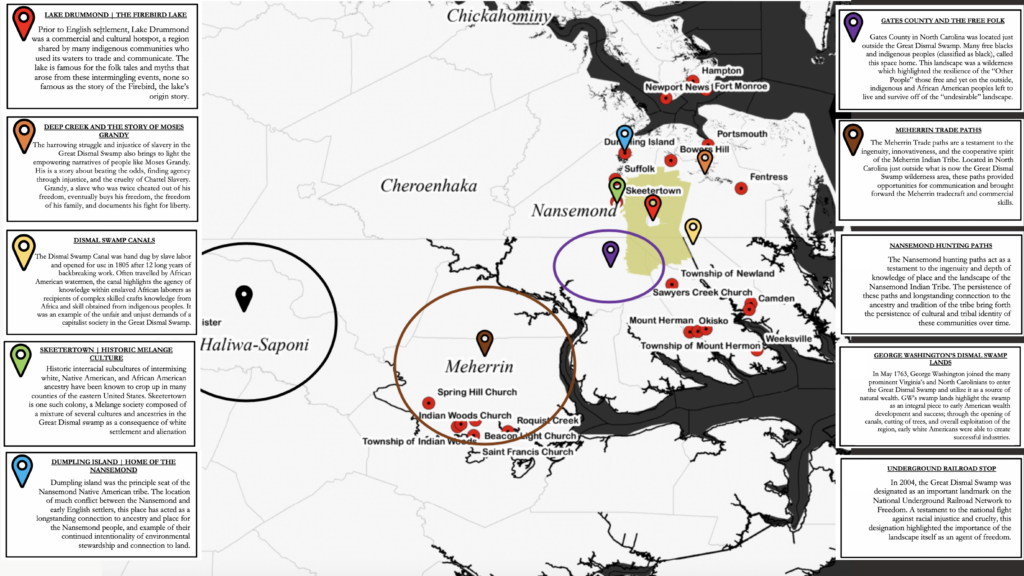
StoryMap Coming Soon ...
Expert Interviews
Alongside our oral histories, this collection includes shorter conversations with practitioners, researchers, and individuals passionate about the rich and underdocumented history of the Great Dismal Swamp and surrounding region. These interviews bring together scholars of the swamp’s history, regional oral historians, and local environmental and environmental justice advocates, adding depth and context to the lived experiences captured throughout the collection.
DR. KATHRYN BENJAMIN GOLDEN
Historian and author of “This Insurgent Ground: Black Women, Marronage, and Rebellion in the Great Dismal Swamp”
Transcript Coming Soon!
DR. DAN SAYERS
Great Dismal Swamp archeologist
Transcript Coming Soon!
YUGONDA SAMPLE-JONES
Founder of the East End Civic Association and resident of Newport News
Transcript Coming Soon!
DR. CHRISTY HYMAN
Geographer and author of “The Cultural Heritage Resilience of the Great Dismal Swamp”
Transcript Coming Soon!
DR. PERRI MELDON
Public historian and National Coordinator for the Mellon Humanities Postdoctoral Fellowship at American Conservation Experience
Transcript Coming Soon!
DAVIDA PLUMMER
Media Coordinator for the Church of God and Saints of Christ
Transcript Coming Soon!
KAY ADAMS
President of the Friends of the Great Dismal Swamp
Transcript Coming Soon!
QUAN MCLAURIN
Civil Rights and Community Engagement Liaison with the Hampton Roads Planning District Commission and the Hampton Roads Transportation Planning Organization
Transcript Coming Soon!
LEIANIS GUNN
Former Hampton Roads organizer for Chesapeake Climate Action Network
Transcript Coming Soon!
UNCOVERING THE DISMAL
Refuge, resistance, and revitalization within one of America’s oldest ecological wonders
This short film is our attempt to capture the Great Dismal Swamp in full: a living ecosystem, a burial ground, a refuge, and a witness. It moves through the swamp’s ecological significance, the maroon communities and Underground Railroad history held within its borders, the Black families and congregations who have called its edges home for generations, and the labor and land exploitation that drained the swamp down to a fraction of its original size.
That history isn’t treated as something separate from the present. Leveraging the above oral histories and expert testimony, the piece draws a direct line from the land’s draining to the flooding now facing surrounding communities, making the case that today’s environmental injustices are rooted in a much longer history of land and labor exploitation in the region. It also looks forward, following a local youth internship program as a new generation learns the swamp’s history and finds their own reasons to care about what happens to it next.
Additional Resources
For those looking to go deeper, the Great Dismal Swamp Stakeholder Collaborative has built its own story map documenting the region’s history. The following represents three years of research, community interview, and development. View it here.
Powered By EmbedPress
In the summer of 2020, in partnership with the Wilderness Society and the Great Dismal Swamp Stakeholder Collaborative, EJOHP’s founder sat down with Eric Sheppard, a descendant of Moses Grandy, to document his family’s connection to the swamp. The resulting essay traces Grandy’s life in bondage along the swamp’s waterways and the slave narrative he published in 1843, Narrative of the Life of Moses Grandy; Late a Slave in the United States of America, now preserved in the University of North Carolina’s Documenting the American South archive.
“When, at length, I had repaid Captain Minner, and had got my free papers, so that my freedom was quite secure, my feelings were greatly excited. I felt to myself so light, that I almost thought I could fly, and in my sleep I was always dreaming of flying over woods and rivers. My gait was so altered by my gladness, that people often stopped me, saying, ‘Grandy, what is the matter?’ I excused myself as well as I could; but many perceived the reason, and said, ‘Oh! he is so pleased with having got his freedom.’ Slavery will teach any man to be glad when he gets freedom.”
– Narrative of the Life of Moses Grandy; Late a Slave in the United States of America.
Viewing the Full Narrative in the University of North Carolina at Chapel Hill Archives
Great Dismal Swamp Coordinator (2024-2026)


Kayla Benjamin
Kayla Benjamin is a D.C.-based communicator focused on telling place-based stories about climate, conservation and environmental justice. She currently works as a conservation campaigns coordinator at the National Wildlife Federation. In her previous role as a reporter for the Washington Informer, Kayla wrote about environmental goings-on in the D.C. region. When she’s not thinking about climate change, solutions-focused storytelling, or the Great Dismal Swamp, Kayla can be found trying new spicy foods or thrift shopping.